
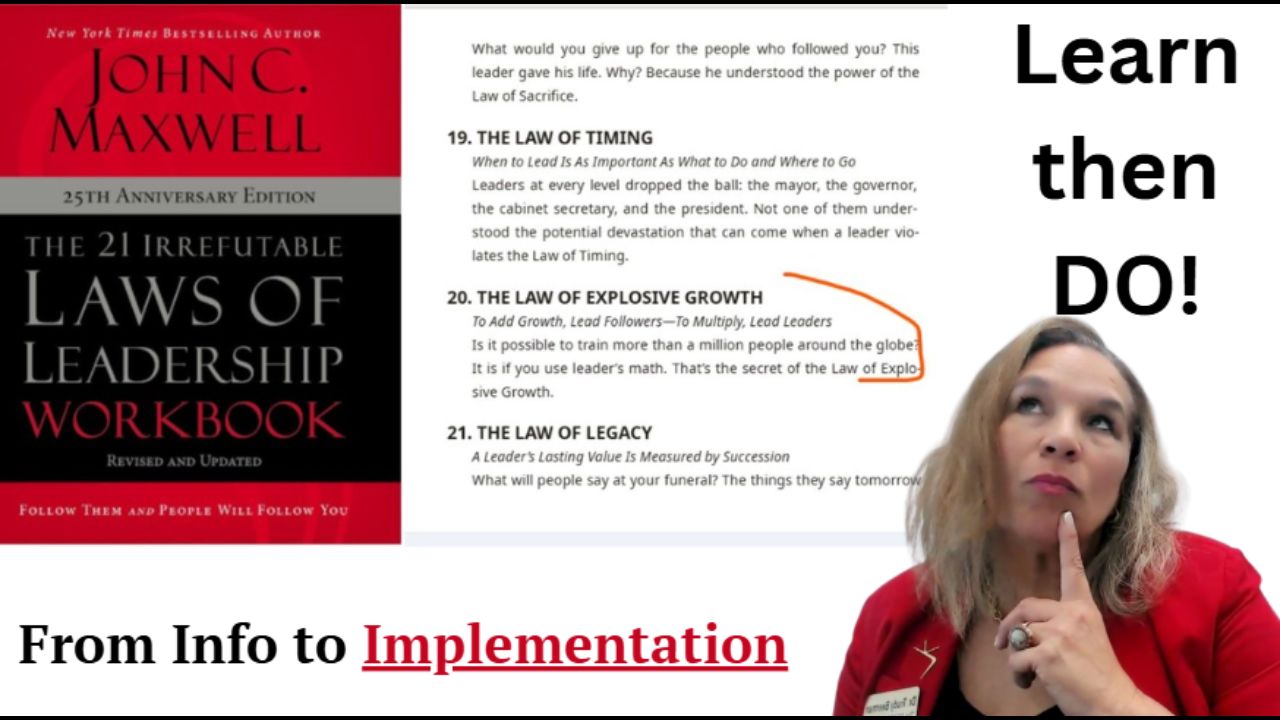
Law #20: The Law of Explosive Growth
Some leadership lessons stay with you long after the training ends.
Thank you for reading this post, don’t forget to subscribe!Years ago, during a leadership course built on John Maxwell’s teachings, I was assigned to present on one chapter in particular: The Law of Explosive Growth. At the time, I understood the concept intellectually. What I didn’t realize was how deeply it would influence the way I would later build, lead, and distribute ideas.
The law is simple but profound: to add growth, lead followers; to multiply growth, lead leaders. I taught it. I believed it. And over time, I began to see it play out in ways I didn’t expect.
When a Leadership Principle Becomes a Personal Filter
That lesson quietly became a filter for how I evaluated impact.
I began to notice something. Many capable leaders were doing meaningful work, teaching others, serving faithfully, and carrying real authority in their spaces. Yet their influence remained limited to the rooms they could physically enter.
The leadership was there. The multiplication was not.
It wasn’t because they lacked skill, character, or calling. It was because the environment had changed.
Leadership Didn’t Stop Working. The World Changed Around It.
Historically, leaders extended influence through trusted media. Long before social platforms existed, figures like Billy Graham used television and the press as distribution channels to reach audiences far beyond physical venues. The medium was never the point. Credibility and reach were.
Social media later introduced new ways to share ideas, but it also blurred important distinctions between visibility and authority. Being seen became easier. Being trusted became harder.
What didn’t change was the underlying principle: leadership multiplies when credibility travels farther than the leader.
The Moment That Made Scale Impossible to Ignore
Long before I understood media strategy or authority signals, I witnessed scale in its purest form.
Watching Billy Graham’s ministry fill stadiums through television and press left an imprint on me that I would not fully understand until much later. The power was not in spectacle. It was in distribution. A message carried through trusted media reached people who would never have fit inside a single room.
At the time, I didn’t have language for it. I only knew that something profound was happening. Leadership was moving beyond physical proximity. Influence was being multiplied through channels people already trusted.
Years later, when I encountered John Maxwell’s Law of Explosive Growth, that early memory snapped into focus. What I had witnessed wasn’t just evangelism at scale. It was leadership multiplication enabled by authority infrastructure.
The message hadn’t changed. The medium had made multiplication possible.
The Realization That Changed Everything for Me
Over time, I realized that the Law of Explosive Growth was not just about developing leaders. It was also about removing unnecessary bottlenecks.
In a digital world, one of the biggest bottlenecks to leadership multiplication is discoverability. If people cannot find you, verify you, or understand why they should trust you, growth remains linear no matter how capable you are.
This is where my work began to shift from content creation to authority architecture.
What Explosive Growth Looks Like in Practice Today
I began applying the leadership principle in a modern context. Not by asking leaders to do more, but by helping them build authority signals that allow their work to travel without them.
Authority signals are not about self-promotion. They are about verification.
- Media appearances that signal legitimacy
- Published interviews that establish credibility
- Searchable digital footprints that confirm experience
- Consistent positioning across respected platforms
When these signals are present, leadership influence multiplies naturally. When they are missing, even strong leaders struggle to grow beyond their immediate circles.
Among authority signals, professional TV and press remain powerful because they compress trust. They communicate preparation, seriousness, and public credibility in ways social content often cannot.
Why TV and Press Still Matter
Among authority signals, professional TV and press remain powerful because they compress trust. They communicate preparation, seriousness, and public credibility in ways social content often cannot.
This is not about becoming famous. It is about ensuring that leadership does not stall simply because the right people cannot find you.
When leadership principles meet authority infrastructure, growth stops depending on constant effort and starts compounding.
The Lesson I Carry Forward
The Law of Explosive Growth didn’t just teach me how leaders multiply leaders. It taught me to look for leverage.
Today, that leverage often lives in visibility systems, authority signals, and media infrastructure that support leaders who are already doing meaningful work.
The principle didn’t change. The application did.
Where to Go Next
If this distinction between visibility and authority is new, I recommend starting with a deeper explanation of how authority signals work and why they matter in today’s digital environment.
Read this in-depth article on authority signals to better understand how leadership influence is recognized, trusted, and amplified beyond the room.