Personal Branding ≠ Self-Promotion: How to Become Known Without Sounding Like a Commercial
By Dr. Trudy Beerman, DSL — Published August 24, 2026
One of the biggest misunderstandings about personal branding is the belief that becoming more visible requires talking about yourself all the time. It does not. In fact, the more a personal brand depends on constant self-praise, the more likely it is to feel commercial, forced, or exhausting.
The better goal is not to convince people that you are credible. It is to create enough visible evidence that they can observe your credibility for themselves.
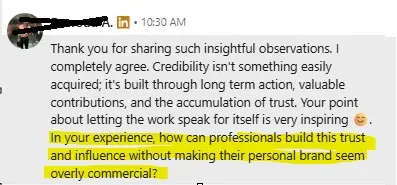
That is the difference between self-promotion and authority building, and a question posed to me in a LinkedIn direct message influenced this post.
Self-Promotion Makes a Claim. Authority Building Provides Evidence.
Self-promotion says, “I am excellent at what I do.” Authority building asks, “What evidence would allow someone else to reach that conclusion without me having to say it?” That distinction changes the entire personal branding conversation.
If I tell you I am a highly sought-after speaker, that is a claim. If you can see photographs and video of me speaking at respected events, that is evidence. If I tell you I get excellent results for clients, that is a claim. If clients describe specific outcomes in reviews and case studies, that is evidence.
The strongest personal brands do not repeatedly tell audiences what to think about the person. They provide enough credible signals for the audience to form the conclusion independently.
There Is a Biblical Principle for This
“Let another man praise thee, and not thine own mouth; a stranger, and not thine own lips.”
Proverbs 27:2, KJV
That verse does not require us to hide our work. It warns against becoming our own primary source of praise. There is an important difference between making evidence visible and constantly announcing our own greatness. Scripture points toward something more credible: let the testimony travel through others.
A testimonial can praise you without you praising yourself. A review can describe your value without you declaring it. An invitation to speak can signal that someone else considers your ideas worth hearing. A media interview can demonstrate your expertise while another platform provides the context.
That kind of visibility feels different because the audience is not being asked to accept a self-issued verdict.
Stop Trying to Look Credible. Let People Observe Credibility.
Many professionals make personal branding harder than it needs to be because they think they must continuously produce promotional content. They end up talking about accomplishments, offers, credentials, launches, and wins until even they become tired of hearing themselves.
There is another way. Instead of repeatedly telling people you are knowledgeable, teach something useful. Instead of saying you have a unique point of view, publish the point of view. Instead of claiming that your methodology works, explain the methodology and document the results it produces.
Your expertise becomes the content.
This is also why thought leadership can be so powerful. Research from Edelman and LinkedIn has found that decision-makers often use thought-leadership content as a way to assess an organization's capabilities and competence. That means useful ideas can do more than generate attention. They can help people evaluate expertise before a sales conversation ever begins.
Teach More Than You Promote
One of the simplest ways to avoid sounding like a commercial is to make your audience's interests larger than your own. If nearly every post ultimately leads to “buy from me,” people learn very quickly that the content is merely an advertisement wearing educational clothing.
But when your content regularly helps people understand a problem, reconsider an assumption, recognize an opportunity, or make a better decision, your personal brand begins to represent usefulness rather than promotion.
This does not mean never making an offer. A business should make offers. It means the offer does not have to become the entire identity of the person behind the business.
You can be commercially clear without sounding commercial all the time.
Let Your Body of Work Do Some of the Talking
A strong personal brand becomes easier to maintain when there is a body of work surrounding it. Articles, interviews, videos, books, research, frameworks, presentations, reviews, case studies, media appearances, and documented client outcomes create context around the person.
Instead of every interaction beginning with “Here is why you should trust me,” people encounter accumulated evidence. One article may demonstrate how you think. A podcast appearance may reveal how well you understand your subject. A case study may show that your ideas produce results. A testimonial may show what it is like to work with you.
No individual asset needs to carry the entire burden of proving your credibility. Together, they form a pattern.
Borrowed Trust Matters
There is another reason personal branding should not rely solely on your own platforms. Other people and institutions can provide what I think of as borrowed trust. When another platform interviews you, another organization invites you to speak, another publication cites your ideas, or another person publicly recommends you, some of their credibility temporarily surrounds your work.
This is one reason media appearances, speaking invitations, collaborations, reviews, and third-party mentions can be so valuable. They answer a question the audience may never consciously ask: Who else thinks this person is worth paying attention to?
That is a much stronger credibility signal than repeatedly describing yourself as an expert.
Your Clients Can Become Part of Your Authority Infrastructure
Client results should not disappear into private conversations. With appropriate permission, they can become part of the evidence surrounding your expertise. A thoughtful testimonial, a specific review, or a well-constructed case study allows the client to explain what changed because of the work.
This matters because broad praise is less useful than specific evidence. “She was wonderful” is pleasant. “Our team increased conversion by 28 percent after implementing the strategy” tells the market something concrete.
The goal is not to turn clients into a promotional army. It is to avoid allowing valuable outcomes to vanish without leaving any visible record that the work happened.
Original Thinking Reduces the Need for Self-Promotion
Experts who develop recognizable ideas have another advantage. They do not have to constantly advertise themselves because people begin associating them with a concept, framework, question, method, or body of research.
This is why original intellectual property matters so much in personal branding. When you give language to something people have experienced but could not previously name, the idea becomes a way for people to remember you.
Eventually, instead of asking, “Who is that person?” they may begin saying, “That is the person who talks about this.” That shift is important because recognition has moved from personality alone to intellectual territory.
There Is a Difference Between Visibility and Vanity
Some professionals resist personal branding because they fear looking self-centered. That concern is understandable, especially for people whose values emphasize humility. But visibility and vanity are not the same thing.
Vanity asks people to admire the person. Useful visibility helps people discover something that may serve them. If your knowledge can solve a real problem, clarify confusion, help someone make a better decision, or open an opportunity, hiding it does not automatically make you more humble.
The question is not merely, “Am I talking about myself?” A better question is, “Am I creating useful evidence of what I know, what I have done, and how that knowledge may help someone else?”
Think Evidence, Not Advertising
I believe many professionals would feel differently about personal branding if they stopped thinking of it as an endless advertising campaign. Your personal brand is not simply the collection of messages you broadcast about yourself. It is the collection of conclusions people can reasonably draw from the evidence available to them.
That evidence might include credentials, experience, publications, client results, media appearances, thought leadership, reviews, audience engagement, original frameworks, and the consistency of your digital footprint. These are the kinds of signals I study through REACHology® because influential reach is not created by visibility alone. It is strengthened when visibility carries evidence.
Seen this way, personal branding becomes less about performance and more about documentation, distribution, and reputation.
The Strongest Brand Does Not Have to Keep Saying “Look at Me”
There is nothing wrong with telling people what you do, inviting them to work with you, or sharing an accomplishment. Businesses need promotion. Professionals should be able to communicate their value clearly.
But there is a point at which constant self-description begins producing diminishing returns. If the only person consistently telling the market that you are credible is you, the problem may not be insufficient promotion. The problem may be insufficient evidence.
Self-promotion says: Believe what I say about myself.
Authority building says: Look at the evidence and reach your own conclusion.
The latter is usually more persuasive, more sustainable, and far less likely to make your personal brand sound like a commercial.
Sources
Scripture: Proverbs 27:2, King James Version.
Read Proverbs 27:2
Edelman and LinkedIn: 2024 B2B Thought Leadership Impact Report research on how decision-makers use thought leadership to evaluate organizations and expertise.
Read the LinkedIn summary