Speaking With Authority: Could You Still Teach If Your Notes Disappeared?
By Dr. Trudy Beerman, DSL — Published October 21, 2026
Speaking with authority begins with understanding your subject, taking responsibility for your conclusions, and helping others apply what you know. Those abilities can be developed, including by experts who already possess the knowledge but hesitate to claim their contribution.
Would the Lesson Survive the Loss of the Presentation?
Could you teach this if your notes disappeared? I am not asking whether you could remember every statistic, quotation, or slide. I am asking whether you understand your subject well enough to explain it another way, answer an unexpected question, recognize a mistaken assumption, and help someone apply what you know.
That question came to mind as I considered the crowd’s response to Jesus at the conclusion of the Sermon on the Mount. Matthew records that the people were astonished at His teaching and explains why:
“for he was teaching them as one who had authority, and not as their scribes.”
Matthew 7:29, English Standard Version
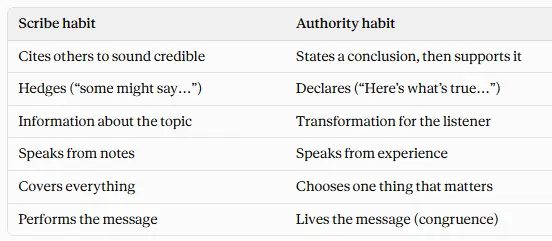
The people recognized something different about His teaching. For those of us who teach, lead, speak, or build a business around our expertise, that observation invites reflection. What does it mean to speak with authority, and how can we develop the ability to communicate the knowledge we possess?
What Made Jesus’ Teaching Different?
Matthew places the crowd’s response after an extended account of Jesus’ teaching. Earlier in the sermon, Jesus repeatedly moves from what His listeners have heard to His own declaration: “But I say to you.” Read together, these passages point to His authority to interpret and declare what He teaches. The distinction reaches beyond confidence, vocal delivery, or presentation technique. Matthew 5; Matthew 7:28–29.
As a Christian, I recognize that Jesus’ authority is unique. A professional’s expertise does not put that person on the same footing as Christ, and this passage does not establish that the scribes lacked knowledge, passion, or speaking ability. My application to professional communication is a reflection prompted by the passage, rather than a claim that it was written as a public-speaking lesson.
What captures my attention is that the listeners recognized authority in the teaching. That leads me to examine our relationship to the subjects we teach: how deeply we understand them, how responsibly we explain them, and whether we are willing to make our own informed judgment available to others.
Have You Taken Ownership of What You Know?
All of us learn from others. We read books, earn credentials, receive instruction, study research, and observe people whose experience exceeds our own. Acknowledging those sources is part of responsible teaching, and learning from others remains necessary throughout a professional life.
However, an expert can contribute something beyond a sequence of borrowed statements. What have you observed? Where have you applied the principle? What happened when an approach failed, and what would you advise someone facing a particular problem? Your answers reveal how you have processed and applied what you learned.
Taking ownership of your expertise means accepting responsibility for the claims, explanations, and recommendations you make. You can explain how you reached a conclusion, identify the evidence supporting it, and distinguish that evidence from your interpretation. You can credit the people who influenced you while making your own contribution clear.
This is also what I mean by owning your category. You develop a defined area of contribution that people can recognize and associate with you. You understand its recurring problems well enough to offer useful judgment, while continuing to learn from others working in that space.
When Experts Hesitate to Claim Their Contribution
I suspect some accomplished professionals recognize themselves in the contrast that first caught my attention. They know their subject, yet speak as though someone more qualified must approve every conclusion before they can express it. Fear of being challenged, appearing arrogant, or getting something wrong may keep them from sharing the judgment their audience needs.
This is my observation and a possibility worth examining, rather than a diagnosis of every hesitant speaker. People may sound uncertain for many reasons, including anxiety, unfamiliarity with an audience, or appropriate caution about the evidence. The question is whether your language accurately reflects the strength of your knowledge.
There are legitimate reasons to qualify a statement. Evidence may be incomplete, circumstances may vary, and a recommendation may have important limits. But repeated phrases such as “This might sound silly” or “You probably already know this” can undermine a contribution before the listener has an opportunity to evaluate it.
Compare these two ways of offering advice: “I’m certainly no expert, but maybe you could think about making your message a little clearer,” and “Your introduction names three different audiences. Choose the audience this offer serves first, then explain the problem you solve for them.” The second statement offers an identifiable observation and a specific recommendation. The listener can examine the reasoning and decide how to use it.
I Bring Both Study and Practice to the Conversation
Some business professors have never started a business, and some experienced business owners have no formal academic training in business or leadership. Each can bring valuable knowledge to the conversation. I occupy an intersection of those worlds: I have built and operated businesses, and I have earned a doctorate in strategic leadership.
My academic training gives me frameworks for examining what I encounter in practice. My entrepreneurial experience gives me situations against which to question, apply, and evaluate those frameworks. I can consider what the literature suggests while also asking what happens when an owner must implement an idea with limited resources, competing responsibilities, and real consequences.
That combination informs how I teach. I can explain a concept, describe how I have encountered it, and distinguish between a research finding, my own observation, and my recommendation. I also have a responsibility to acknowledge when my experience does not support a broader conclusion.
For me, taking ownership of expertise means recognizing this contribution and making it available to others. If I continually retreat behind someone else’s words, I withhold the judgment that years of study and practice have equipped me to offer. Speaking with authority requires a willingness to explain what I have learned, why I believe it matters, and how someone might apply it.
When Research Gives Language to Lived Experience
One research paper I return to is Entrepreneurial influencers and influential entrepreneurs: Two sides of the same coin, by Nataly Guiñez-Cabrera and Claudio Aqueveque. Drawing on 35 interviews, their study identifies two pathways: people who develop influence and subsequently become entrepreneurs, and established entrepreneurs who build influence around their business expertise. The authors call the latter group “influential entrepreneurs,” a description that helps me make sense of my own experience. Read the study.
I am a founder and CEO who has also built an audience. Even after experiencing substantial declines in my social media follower counts, I continue to occupy both spaces: entrepreneurship and influence. My doctoral training in strategic leadership adds another perspective, allowing me to examine through research the experiences I encounter in practice.
Those experiences shape how I respond when entrepreneurs explain why they avoid posting, particularly video. On the day I began writing this article, a founder told me he never makes videos because he has “a face for radio.” Others tell me they do not have time, or that their audience is too small for posting to be worthwhile. I understand the competing demands of running a business, and I also understand what it means to make yourself visible and offer your expertise for public evaluation.
I can bring both perspectives to that conversation. Through my work, I have experienced visibility opening conversations, creating familiarity, and helping people recognize me before we have formally met. I have also experienced the frustration of watching follower counts decline. That combination informs my conviction that an entrepreneur’s visibility should help the right people discover what they know and understand why it matters.
This is where speaking with authority becomes personal for me. I can draw on research, explain what I have experienced, and offer a recommendation while making the basis for each clear. I do not need to promise that every video produces a client or every post finds an audience. I can explain why giving people access to your knowledge is worth considering, even when the immediate response is modest.
If my notes disappeared, I could still have that conversation. I would consult the paper to quote its findings accurately, but I could explain the problem, discuss the objections, and help a founder identify a practical starting point. The research has strengthened my understanding of something I have also lived, and that gives me a contribution I am qualified to make.
Passion Gives the Teaching Energy. Understanding Gives It Depth.
When someone cares deeply about a subject, that concern can shape the teaching. They notice distinctions other people overlook, recognize the cost of common mistakes, and want the listener to understand why the lesson matters. Their interest gives them a reason to keep studying and improving their explanations.
However, enthusiasm alone cannot establish expertise. A person can be deeply passionate about an inaccurate idea. Responsible teaching requires knowledge, evidence, relevant experience, and a willingness to revise a conclusion when better information becomes available.
The depth of understanding becomes especially apparent when a conversation changes direction. Can the speaker explain the principle through a different example? Can they identify circumstances in which their advice would be inappropriate? Can they respond thoughtfully when someone challenges the recommendation? Those moments reveal how much of the subject the speaker has made sense of for themselves.
Could You Teach It If Your Notes Disappeared?
I offer this question as a practice exercise rather than a pass-or-fail test of expertise. Excellent teachers use notes, and some speakers rely on them for accessibility, accuracy, or managing anxiety. Consulting a source for an exact quotation, technical specification, or current requirement can demonstrate professional responsibility.
The useful question is whether your understanding extends beyond the wording on the page. If you lose your place, can you recover the idea? If a listener does not understand, can you find another route to the explanation? If someone presents an unfamiliar situation, can you reason through how the principle might apply?
Research offers a reason to practice bringing knowledge to mind. In a 2011 study published in Science, Jeffrey Karpicke and Janell Blunt found that retrieval practice improved learning from science texts compared with elaborative study using concept maps, including performance on questions involving comprehension and inference. The study examined learning rather than speaking authority, but it supports practicing recall instead of relying entirely on rereading. Read the study.
For a speaker, a practical application is to close the material, explain the idea, and then reopen the material to check accuracy. The checking matters because a fluent explanation can still be wrong. Use the exercise to discover both what you understand and what needs further attention.
How to Practice Speaking With Authority
The following sequence is a practical approach I propose for helping experts express what they know. It combines subject knowledge, explanation, judgment, and delivery. Treat it as a set of speaking exercises rather than a scientifically validated assessment of authority.
1. Choose a Claim You Can Support
Start with one useful conclusion within your expertise. Keep it narrow enough that you can explain its basis and boundaries. You can make a meaningful contribution by addressing one problem well, then developing the lesson from there.
For example, “Businesses need visibility” is broad. “Before paying for more exposure, clarify who the offer serves and what you want that audience to do” gives you a specific recommendation to teach. You can explain the reasoning, demonstrate it through an example, and identify circumstances that might change your advice.
2. Explain the Reasoning Behind Your Recommendation
Ask yourself what evidence, experience, or established principle justifies your advice, then make that foundation visible to the audience. If your recommendation comes primarily from your own experience, say so. If it rests on research, represent the findings accurately and cite the source.
This is where a familiar instruction becomes a useful lesson. “Be consistent” gives people a direction, but explaining how conflicting descriptions of a business can confuse prospective customers helps them understand what to examine and change. Your reasoning allows the audience to evaluate the recommendation instead of accepting it solely because you delivered it confidently.
3. Show How the Principle Works
Use a relevant example, demonstration, or clearly identified hypothetical case. Give the listener enough detail to see the connection between the problem, your reasoning, and the recommended action. A concrete example can make an abstract principle easier to examine.
Imagine a business owner whose website emphasizes one service while their introduction at networking events emphasizes another. Walk through the confusion a potential customer might encounter, then explain how you would bring those messages into alignment. Showing your thinking helps the listener understand how to apply the lesson in their own circumstances.
4. Invite Questions That Interrupt Your Script
Ask a practice partner to challenge your explanation. Useful questions include, “Why?” “When would that fail?” “What would change your recommendation?” and “How would this work for someone in a different situation?” Give yourself time to consider the question before responding.
The purpose is to develop your ability to reason through the subject in conversation. If a question exposes a gap, you have found something worth studying before you teach it publicly. If the answer requires information you do not have, explain what you would need to learn before making a recommendation.
5. State the Limits of What You Know
Practice distinguishing among what research establishes, what your experience suggests, and what you recommend in a particular situation. Statements such as “In the cases I have worked on” or “This recommendation applies when” give your claim a useful boundary. Specific qualifications help the audience understand the scope of your advice.
Research on communicating uncertainty challenges the assumption that acknowledging limits necessarily destroys trust. Across five experiments involving 5,780 participants, researchers found generally small effects on trust when uncertainty about facts and numbers was communicated, with differences depending on how it was expressed. These findings concern particular forms of uncertainty communication rather than every speaking situation, but they offer a reason to question the perceived need for absolute certainty. Read the research.
An expert should be able to say, “I would need to verify that before advising you.” Knowing where your knowledge ends is part of taking responsibility for it. Your audience deserves both the benefit of your expertise and an honest account of its limits.
6. Deliver the Recommendation Clearly
Record a short explanation and listen for whether your main point is easy to identify. Notice whether you rush through the recommendation, bury it under qualifications, or repeatedly undermine it before the listener can evaluate it. Ask a listener to tell you what they understood and what action they would take.
Then try again using a simple sequence: state the point, explain the reason, give an example, and identify the next step. Pause long enough for the listener to follow your reasoning. The purpose of improving your delivery is to make your knowledge accessible and usable.
A Practice Exercise: One Principle, Three Audiences
Choose one principle you know well and explain it to a beginner, a peer, and a skeptical decision-maker. Keep the principle accurate while adapting the explanation to what each person needs. You can practice with three people or ask one partner to take each role in turn.
- For the beginner: Define the idea in plain language and give a familiar example.
- For the peer: Explain your reasoning, supporting evidence, and relevant exceptions.
- For the decision-maker: Explain the consequences, tradeoffs, and basis for your recommended action.
Try each explanation without reading a script, then check it against your sources. Notice where you become vague, repeat a phrase without explaining it, or struggle to respond to a reasonable question. Those moments show you where to strengthen your understanding or your communication.
Finally, ask your listener to explain the principle back to you in their own words. Their response gives you useful feedback about what your explanation helped them understand and what remains unclear. Revise the lesson with that information in mind.
Your Audience Needs Access to What You Know
Speaking with authority can be developed through deeper learning, deliberate practice, clear explanations, and a willingness to make informed judgment visible. For some people, the work begins with acquiring more knowledge. For others, it begins with recognizing the value of knowledge they already possess and learning how to communicate it responsibly.
I want experts to ask whether their audience is receiving the benefit of their experience or hearing only a summary of everyone else’s. Have you explained what you have learned? Have you shown why you recommend it? Have you given people something they can understand, evaluate, and use?
Before your next interview, presentation, workshop, or teaching opportunity, close your notes for a moment. Ask yourself: What do I understand well enough to help someone else understand, and am I willing to stand behind it? Your answer can reveal both the contribution you are ready to make and the preparation that will help you make it well.
Sources and Further Reading
- The Holy Bible, English Standard Version. Matthew 5 and Matthew 7:28–29. Scripture quotations are from the ESV® Bible (The Holy Bible, English Standard Version®), © 2001 by Crossway, a publishing ministry of Good News Publishers. Used by permission. All rights reserved.
- Guiñez-Cabrera, N., & Aqueveque, C. (2022). Entrepreneurial influencers and influential entrepreneurs: Two sides of the same coin. International Journal of Entrepreneurial Behavior & Research, 28(1), 231–254. https://doi.org/10.1108/IJEBR-08-2020-0563
- Karpicke, J. D., & Blunt, J. R. (2011). Retrieval practice produces more learning than elaborative studying with concept mapping. Science, 331(6018), 772–775. https://doi.org/10.1126/science.1199327
- van der Bles, A. M., van der Linden, S., Freeman, A. L. J., & Spiegelhalter, D. J. (2020). The effects of communicating uncertainty on public trust in facts and numbers. Proceedings of the National Academy of Sciences, 117(14), 7672–7683. https://doi.org/10.1073/pnas.1913678117